 We have one on every wall of our living room. We’re pretty sure the house plans only included the one normal light bulb hanging from a cord in the middle of the ceiling, but somehow we also ended up with the hongera lights. When turned on, they alternately flash lavender, turquoise, purple, yellow, red, and green. At night our living room looks like an empty discotheque.
Mind you, the cabinet doors don’t close, the bathroom light switch turns on the light in the room next to it, and the back door was installed with a 4-inch gap at the bottom – but the hongera lights work perfectly. Priorities, priorities.
Mid-July marked the 12th week of our Savings Clubs. Members can now apply for loans from their group’s savings. The groups whose members have met their savings goal every week during the 12 weeks qualify to have Nuru match their loan amount, doubling the principal they have to loan from. This is Mkombozi, one of our best groups, signing their loan contracts. 
I’m realizing how much infrastructure I took for granted when I was working with Pro Mujer. All of the paperwork, accounting, and information management systems were in place. Now I am building all those elements from scratch, trying to figure out what applies or is necessary. Thus far, Savings Club deposits are issued a receipt which is then recorded in a journal. The addition used in said journal is questionable, as is the accuracy of the group name under which the transaction was recorded (does the deposit recorded under “Vision Group” belong to Vision Farming or Nyaihungurumo Vision Group??). Apparently, receipts weren’t issued for withdrawals so we have no formal record of these, just notes scribbled in the margins of the Office Manager’s notebook. The loan contracts we’re using were written the night before we issued the loans.
The beauty of Savings Clubs is that many of the management tasks (such as how much each member contributes and when) are the responsibility of the group representatives. But we are going to need to establish more formal and detailed procedures for the program. It feels inappropriate to push for electronic record keeping when the Nuru office in Nyametaburo is operating off a solar panel and gets invaded periodically by chickens or goats, but we’re growing so quickly that the volume and complexity of transactions is going to require it soon. Besides, Nuru is responsible for this money and we take that seriously. A lot of our members have never saved before, and we owe it to them to have every detail in place to keep it safe. So I can be as OCD as I want! Perfect.
Sunday, August 16, 2009
Hongera!


Sunday, August 02, 2009
Never Drop a Muzungu
 We live in a town about 7 km from the villages we work in, and take piki piki (motorcycle) taxis to work. It has to be the best morning commute in the world: good Kenyan coffee and zipping to work on a motorcycle down a dirt road surrounded by rolling green hills, golden maize fields, giant boulders, bright banana trees and thatched huts. Children near the roadside wave enthusiastically, screaming “muzungu!!” (it means white man, but works for all foreigners). The first few minutes after I get off a piki piki my face always tickles. I think it’s from my hair whipping around during the drive; I call it the motorcycle fuzzies.
It’s the last week of our transition with Foundation Team 2. Jesse, our imported media guru, arrived to tape episode 6, which focuses on the CDC (Community Development Committee, the Kenyan counterparts of the Foundation Teams). Their official titles are field managers and they are amazing, selfless community leaders. Philip Mohochi, the Chairman, is technically the field manager of my program but we are searching for a replacement because Philip is quickly becoming too busy to be both chairman and field manager.

My program is Community Economic Development (CED), started last season by Aerie. During our transition we’ve been working on a 5-year plan for the program, focusing on a ground-up, community-driven approach to economic development. This is what we’d like to do:
* Train Nuru members to save, budget, and plan.
* Provide skills training and small business development programs.
* Start a community development fund which will be the basis for a village savings and loan program, as well as make sure all Nuru program operations are able to sustain themselves.
I’m lucky to be here at a time when we start implementing a lot of the ideas that have been developed. It’s exciting and intimidating; we have ideas but I don’t want to assume anything. So far, the communities we work with have been incredibly welcoming, so I want to deserve that trust.

My Swahili is pretty pitiful because most of my co-workers speak English and I’m using that as a crutch. I have some stock phrases I’m using for now, which usually makes the Kenyans laugh. It’s like when the kids greet me yelling ‘Bye! Bye!’ (I’m not exactly sure why they know ‘bye’ but not ‘hello’) and I laugh and greet them back with ‘Bye! Bye!’. Not correct, but for now we understand each other.
“Never drop a muzungu! They are very fragile!” – shouted at Aerie and his piki piki driver by a passing motorcyclist
Friday, July 24, 2009
Hyperphagia
 In the summer, black bears begin hyperphagia, a period of excessive eating and drinking to fatten for hibernation later in the fall. Their bellies will literally drag the ground from over-eating. This is how I feel in the weeks before I leave for Kenya. I am gorging on cheese, burritos, pad kee mao, bagels, Chinese food, ice cream, pretending that if I eat enough of my favorite foods now, I won’t miss them in the next 6 months. As my food baby grows I feel guilty; I am going to Kuria, where there is a hunger season. Families habitually run out of money and go hungry in the months before the harvest, and I am shoveling 3,000 calories-worth of smoked gouda into my mouth.
 In Nairobi, the acrid smell of burning plastic reminds me of Bolivia, and it’s strangely comforting. The back of the bus in front of us has ‘Gangsta for Life’ painted in giant letters. The scenery between the capital and Nyanza province is a sweeping landscape dotted by acacia trees before it opens dramatically into the Great Rift Valley. Sadly I miss much of this, sleeping/blacked out in the back of the bus, my arms and legs pinned down by boxes and bags. But whenever the bus hits a rough patch of road and slams my head into the window (about every 15 minutes), I wake up long enough to admire the view. Our long trip, timed by David at 51 hours, finally ends and Foundation Team 3 stumbles off the dusty bus in Isibania. I am sticky and have dirt in my teeth from the dust that billowed in the bus windows. Feels like home.

It is week 1, and now it’s like mental hyperphagia. I am on information overload. Nuru’s model is built on collaboration between program areas, basic sanitation affects health affects income generation, and so on. So our transition begins by shadowing all other programs before we dive into our respective areas next week.
Wednesday, October 08, 2008
The End


In the last months of my service, I spent July working with Pro Mujer in the largest department of Bolivia, Santa Cruz. Their rural credit program is based out of 2 intermediary centers in Ascencion de Guarayos and San Ignacio, 6 and 12 hours outside Santa Cruz city, respectively. I worked with the staff on training and ran a diagnostic on community priorities for business and health services. We went to tiny, beautiful towns reached only by motorcycle and sometimes cramped public minibuses, where the women delightedly shared their chicha de mani and let me swing in their hammocks while we talked. I wish I had more time to work with them and be in those towns.
My runs were on coppery sand roads through flat grassy estancias and thick patches of palm trees, with squawking parrots and reproachful cattle. Even in the early morning the heat and humidity were strong. I ate a lot of yucca and discovered fried cunape (as if cunape could get any better!).
In August I resumed working with the Centro Solidario, a state home for juvenile delinquents. Our last project was to paint a world map mural, which is what we were doing when I got the call from Peace Corps to evacuate. Like most volunteers I disappeared overnight, without time to say goodbye or explain to my friends, family, co-workers. In Lima I waded through the necessary reports, paperwork, and medical tests to finish my service. At the first modern mall I have seen for years, I found out I can eat half a Pizza Hut pie and 7 Dunkin Donut holes in about 12 minutes.


On September 22 I officially closed service. There is quite a migration back to Bolivia. There are 6 of us in the first group to go back; 4 buses in 30 hours straight and sunset on Lake Titicaca is Bolivia's welcome home to us. Today we finished our World Map Project. I have said my goodbyes and packed my things. Next week I go to Tarija where I will leave Bolivia for Argentina, then home. I can't wait to see everyone, who sent the e-mails, mail, thoughts & support that meant so much to me these last 2 years. Thanks & happy travels.
Monday, May 19, 2008
The Crater of Maragua
 Maragua used to be a Peace Corps site, the kind now extinct because they realized if they ever need to evacuate the country it is not very convenient to have a volunteer in a place that requires a 4-hour hike and crossing a river nicknamed "the Killer of Maraguans" before hitchiking into the city on a cattle truck. The trip there isn´t quite as bad, except when we ask to be let off on the road to Maragua the driver asks, "Which Maragua?" There are 3. Ohh, good.

It is almost 3 hours up the crater walls, winding through the surrounding mountains and cutting across fields, where Don Basilio stops to chat with whoever´s land we´re on. At the edge of a field, rising abruptly up from a ravine is a large slab of smooth gray stone. I climb onto it looking for strange looking obscure little marks and trip into a large, 3-toed dino track. The different tracks criss-cross the slab everywhere with incredible clarity. I am sure we are not supposed to be walking all over them like this but as Chris points out cheerfully, this is why we´re in Bolivia. A cholita herding sheep appears with a little guest book to sign and collects 10 Bs. from each of us as we stretch out on the warm stone in the sun next to the tracks and doze. It's unreal and incredible. I love Bolivia, that I get to do things like this. We spend the rest of of the day hiking to a waterfall next to a fanged cave called the Devil's Mouth, then up to the cementery. Russ has his binoculars and sees a woman baking bread in her domed earthen oven otuside. He hikes down to buy some for dinner, still steaming hot. Water gets collected from a "spring", a tiny burbling hole at the side of the muddy trickle of water that passes for a stream, liberally sprinkled with goat poop. We boil it a long time and tell ourselves the floaty things are dead.
 We get up early the third day to hike out to the road because buses and trucks only pass by for a few hours in the morning. There is not much traffic at all, we get passed by 2 buses and a truck, jammed full. Finally another cattle truck, also full of people and animals and cargo, pulls up and looks at us doubtfully. Before they change their minds we scramble into the back. Everyone is able to climb up the inside sides of the truck bed and get some fresh air, but Kate and I are stuck in the human soup in the back bottom. She is between a fat boy and an old man sitting on rice bags who keeps kicking her legs, I am between some sheep and a cholita seated on flour sacks using me as her back rest. I think I have the better situation until the ram at my knees starts biting. I squeal and try to move but it's impossible. Ram bites. I squeal. The campesinos find this hilarious but trust me, it is not. I decide to fight the sheep. The next time he bites, I manage to land a kick. The sheep pauses, then begins to head butt at my knees. Hard. I kick. Sheep butts. This is stupid. I make a roaring noise and punch him. Sheep is stunned. I win! Sheep pees on me. Sheep wins. I hate Bolivia. Thus pass another 3 hours rattling down a dusty road drowning in odors of unwashed bodies and livestock feces. This is the price you pay for walking in dinosaur tracks.
Tuesday, April 15, 2008
Team Reetz
The next day, we are in the Biocentro Güembe, a butterfly reserve encased in a little bubble of well-tended tropical greenery, luxurious pools and waterfalls, and the ubiquitous but prettier-than-usual boys from Israel. It always feels like vacation in Santa Cruz; chic restaurants, expensive wine, wearing sundresses in humidity that stifles any movement other than drinking beer by the pool.


 We continue on to my anxiously-planned Tour de Sucre. Sucre graciously humors me with the impossibly blue, blue skies and dazzling sunshine I had hoped to present the White City in. Saturday is Día de los Niños y Niñas so we go to the party at my orphanage. I am “madrina” of the cake, which involves balancing a drum-sized cake on my knees while at the mercy of the driving of a Bolivian taxista. Absolutely terrifying. Bolivians always march around carrying entire cakes from the market on a skinny piece of styrofoam. They make it look so easy.
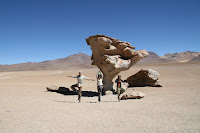

 We use Toñito Tours for our Salar de Uyuni trip, a private jeep for our group of 5½ (Elliot counts as 1½) and we customize the tour route. Bolivia is a consistent if not gracious hostess; she dishes out some gnarly GI infection to both Carolyn and Nichole within a day of starting the tour. It isn’t the most pampered place to be sick, but the Salar de Uyuni and southwest circuit of the Eduardo Avaroa Reserve is one of the most amazing places I have ever been. Mineral lagoons tinted blood red, slate, or teal and sprinkled with pale pink flocks of flamingos, geyser fields, luminescent deserts crowned with bizarre rock structures, and sunrise on the world’s largest salt flat. The legends explain it as a dried sea of tears shed by the Mother Mountain, after her love child with another mountain is stolen by her jealous lover.
 It is blinding and immense, not soft like the snow it appears to be, and etched into an eccentric patchwork quilt by the ridges left behind by water that rises to the surface. It doesn’t crumble easily; there are no footprints. The salt burns my chin where I’ve been resting my head on the ground to take perspective pictures of us popping out of wine bottles and hugging giant iPods. The trip ends in the train graveyard, an unlikely (read: only in Bolivia) tourist attraction of silent giants, after 3 days of car games and an unhealthy number of lollipops.
FUN FACT / QUOTE OF THE DAY: "Is there a Ritz in Bolivia?" “Ahahaha!…black people.” “Ok, but God made Israel for me.” “Hostile colon!” “Your Mom´s from Chile.”
Saturday, March 15, 2008
Back Post
 It was not a good week, so instead I will back post something happy. This is a trip I took in the Cordillera Real last October, the Andean range northeast of Lake Titicaca in La Paz:


 Not visual enough? Ok, here’s me with the group at 9000ft:

Humbled, I concentrate on how amazing it is to be here; the spring of moist pasture under my boots, tiny Sorata in the valley below, the welcome bite of primitive wind across my flushed face and the thud of my heartbeat in my ears as we gain altitude and lose air. It is barely noon when the fog moves in, ghostly beautiful over ponds lying like mirrors in grass and crumbled shale, but I have to strain to keep sight of Chris and Don Octavio.


 Well, brief sun, a glimpse of the amazing view below that should be haunting each step of this trip, then the fog moves back in.
 Up, up, up. Step, breathe, step, breeeathe. Last 2000 ft of climb but in the fog and water running all down the mountain we lose the trail to the Laguna Glacier. A myriad of rock cairns lead us up over a moraine. We reach the top – GLACIER! But not the right one. It’s unidentified on the map so Chris names it Tortila and I name it Baby Llama and we call it a day.

 We’re at 5000m, no altitude sickness but I can’t sleep. It’s snowing, which caps the tent like saran wrap and the condensation drips on my face all night while the thunderous sound of glacial ice calving sounds a lot spookier and closer now that I’m trapped in a tent.


The morning is brilliant in blue and white. Breakfast, the worst muesli in the world, freezes to my hand. I settle for my mountain mocha (Nescafe+Swiss Miss) and my glacier view. We spend the morning hiking over the next moraine but still no Laguna Glacier. The unwelcome fog drifts back in and we enjoy our last view of Lake Titicaca from 16000 ft.


 The Cordillera Real is 100 miles, from Illimani overlooking La Paz in the southern end at 21125ft to the northern view before me, in the shadow of Illampu (20892ft) and Ancohuma (21086ft).
 Back down to sub-9000ft. Fin!


 Posts

